
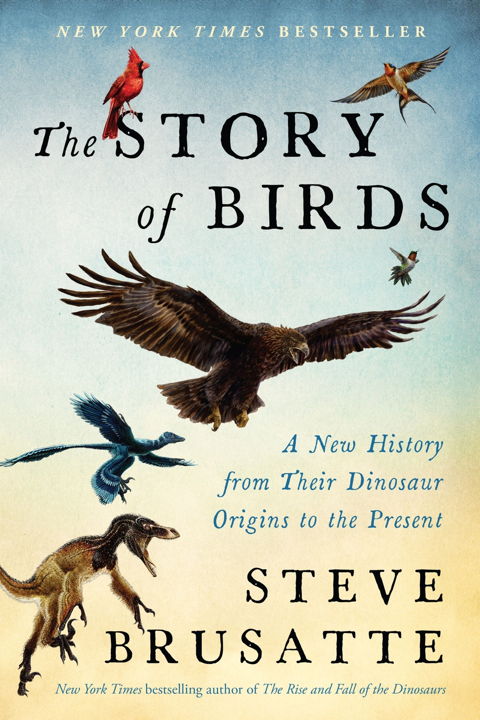

It’s a scientific fact that birds aren’t just descended from dinosaurs; they are dinosaurs. It’s a fact, but it’s also an oversimplification: it glosses over the evolutionary innovations that took small carnivorous dinosaurs and turned them into the birds we know today; it also overlooks the evolutionary developments, and dead ends, after the asteroid wiped out what we now refer to as the non-avian dinosaurs: the dinosaurs that aren’t birds.
These are the gaps filled by Steve Brusatte’s new book, The Story of Birds, the third of his popular paleontology books, after The Rise and Fall of the Dinosaurs (2018) and The Rise and Reign of the Mammals (2022). Having read and enjoyed the previous books, I knew what to expect this time around: an evolutionary history that starts earlier than you’d expect, talks about current research, and reframes the narrative around the group of animals under consideration. It’s more of the same—and that’s a good thing.
After going over how the bird-dinosaur link was established and the discoveries of fossil dinosaurs with feathers, Brusatte tackles some fairly simple but fundamental questions. Where is the line between dinosaur and bird? Where did feathers and beaks come from? When did flight start happening? These are, it turns out, not the same question. And why did birds survive the asteroid when larger, non-avian dinosaurs didn’t? (One answer: food. Seed-eaters had a better chance of survival.)
He also looks at the evolutionary paths birds took thereafter, as they rapidly filled all sorts of ecological niches, such that there have been multiple times and places across the Cenozoic where birds, not mammals, dominated. Also, most of the bird groups we know today have been in place for a very long time: there were hummingbirds and penguins tens of millions of years ago. (Giant penguins were once the ocean’s apex predator long before the whales showed up.) And speaking of niches, it turns out that flightlessless was evolved more than once, in multiple groups, and even multiple times within a single group: it seems to be trivially easy to convince a species to stop flying if they can get away with it.
As for bird intelligence—think about how scary smart corvids and parrots can get—the section on bird cognition describes some fairly grisly methods to count neurons in avian brain tissue: it turns out that songbirds, especially corvids, get around the brain-size-versus-body-mass question by having brains be twice as neuron-dense as mammalian brains.
All of this is informed by research current enough that he had to revise this book as he went along because his colleagues kept finding new things. As I said in my review of his first book: science as a verb. Who knows what will be discovered next, or how quickly this book will become dated.
In the meantime, this is a fine concluding volume to an unexpectedly accessible paleontological trilogy.